

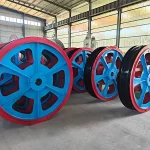

Mine hoists, commonly known as “mine winders,” act as the vital lifeline for vertical transport in mining. They actively elevate personnel, ore, equipment, and materials from underground to the surface. Furthermore, they efficiently transport loads between different mine levels. Ultimately, this critical system consists of the following core components:
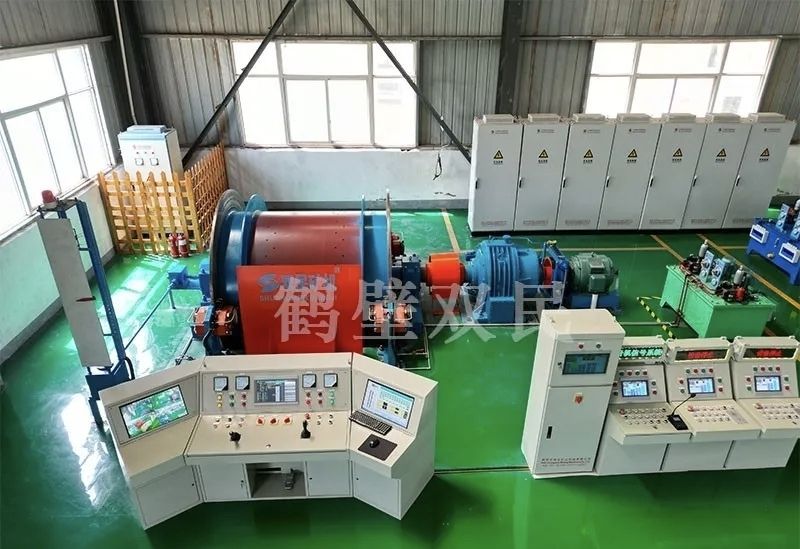
Power system
This system acts as the heart of the hoist. It primarily consists of a high-voltage motor, a gearbox, and couplings. The motor first generates the initial rotational force. This power then transfers to the gearbox via the couplings. Subsequently, the gearbox effectively reduces speed while significantly increasing torque. Ultimately, it delivers the immense strength required to lift heavy conveyances, like skips or cages.
Hoisting unit
This assembly actively performs the hoisting mission. It primarily consists of a drum (or winding roller) and steel wire rope. The drum efficiently stores and winds the rope. Then, driven by power, it rotates forward or backward. This motion smoothly reels the rope in or pays it out. Consequently, it directly moves the conveyance up or down the shaft. Finally, drum designs vary and mainly include single and double-drum types.
Braking system
This system serves as the vital safety lifeline for the hoist’s operation. It incorporates two independent systems: the service brake and the safety brake. The service brake actively controls speed during normal stopping procedures. In contrast, the safety brake activates automatically during emergencies like power loss or overspeed. It then applies immediate braking to securely halt the system. This crucial action effectively prevents accidents and ensures total reliability.
Control system
This unit functions as the brain and nervous system of the hoist. Modern hoists widely utilize advanced, automated control systems. These systems primarily include PLCs and frequency converters. They precisely manage every operation: startup, acceleration, cruising, deceleration, and stop. Furthermore, they continuously monitor key parameters like speed, position, and load. Consequently, they guarantee that every lifting cycle strictly follows predefined safety protocols.
Auxiliary equipment
These components are essential for the hoist’s smooth and complete operation. They primarily include a lubrication system, a depth indicator, and an overwind protection device. Additionally, various monitoring instruments and safety circuits are integral parts. The lubrication system continuously supplies oil to bearings and gears for cooling. Meanwhile, the depth indicator actively displays the conveyance’s real-time position. Most importantly, the overwind protection device automatically prevents the conveyance from over-traveling. Finally, all instruments and circuits work together to ensure comprehensive monitoring and safety.
In summary, a mine hoist is a sophisticated system integrating mechanical, electrical, and control technologies. All its components work in seamless harmony. Ultimately, this synergy guarantees both highly efficient and exceptionally safe mining hoisting operations.
