


1. Overview
In deep shaft mining, hoists are critical equipment. They directly impact transportation efficiency and safety. Two main types dominate: multi-rope friction hoists and single-drum winding hoists. Each type has distinct characteristics. The following analysis compares their differences and helps select the better solution for deep mines.
2. Working principle
Multi-Rope Friction Hoist: This system drives through friction between ropes and sheave. It utilizes 4-6 parallel ropes for load distribution. The design handles heavy loads efficiently. It achieves high-speed operation in deep shafts.
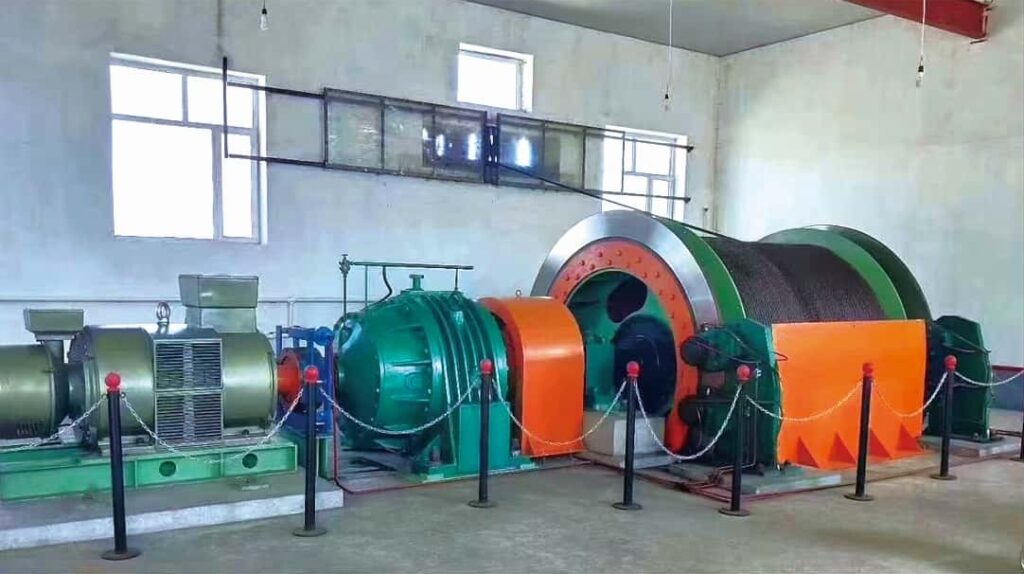
Single-Drum Winding Hoist: This type winds ropes directly on a rotating drum. Its mechanism offers straightforward operation. However, rope wear occurs more rapidly. It works best for medium-depth applications.

3. Performance comparison
Hoisting Depth: Multi-rope systems excel beyond 1000m depths. Single-drum types typically max out at 800m.
Hoisting Speed: Multi-rope achieves 12-20m/s for faster cycles. Single-drum operates at 6-12m/s speeds.
Rope Longevity: Multi-rope minimizes wear for extended service life. Single-drum’s repeated winding accelerates wear.
Safety Features: Multi-rope’s redundant design enhances reliability. Single-drum carries inherent single-point risks.
4. Applicability analysis
Multi-rope friction type: suitable for deep wells and large mines, can withstand high loads, and has better long-term economic efficiency.
Single rope winding type: suitable for shallow wells or projects with limited budgets, with low initial costs but high maintenance costs.
For mines deeper than 1000m, multi-rope friction hoists prove superior. They offer higher load capacity and extended service life. Their redundant design ensures maximum operational safety. For shafts under 800m, single-drum hoists present a cost-effective alternative. They reduce initial investment while maintaining basic functionality. Looking ahead, intelligent multi-rope systems will dominate deep mining. These advanced hoists integrate smart monitoring technologies. They represent the future of efficient shaft operations.
